Blog Post 5: AI & Social Media
What are the Risks and Opportunities That AI Introduces for Digital Citizenship?
Kadri, N. (2024). A sign with a question mark and a question mark drawn on it [Photograph].
Artificial intelligence creates new opportunities, as well as challenges, for digital citizenship within Canadian education. There are major concerns around the spread of misinformation and disinformation online due to AI-generated outputs. Deepfakes can also make false information seem real, making it more difficult for students to determine what is trustworthy or not. The Government of Canada (2024) explains that AI has made it easier to create and spread disinformation. MediaSmarts (2025) also discusses the growing issue surrounding AI-generated misinformation. MediaSmarts (2025) similarly highlights the growing concern surrounding AI-generated misinformation and emphasizes the importance of critical thinking and verifying online information. AI also creates concerns around academic integrity, as students are starting to accept AI-generated information without checking the accuracy. There are also concerns around bias and privacy surrounding AI in education.
However scary this may seem, there are opportunities that AI can provide for education in Canada. AI can support learning by providing feedback, helping students brainstorm, encouraging creativity, and supporting accessibility through tools like speech-to-text. When used right, AI can help students develop skills like problem solving and technological literacy. For example, when students critically evaluate the information AI gives them instead of accepting them right away, they develop both stronger problem-solving skills and greater technological literacy.
The Government of Canada’s (2026) National Artificial Intelligence Strategy discusses ways we can use AI for education and training, improving public services, and supporting innovation. This strategy suggests that students should be taught how to use AI responsibly rather than simply being encouraged to avoid it. As MediaSmarts (2025) discusses, critical media literacy is becoming more and more important as Canadians come across more AI-generated content online.
The Role of Media Literacy Education in Helping Learners Assess AI-Generated Content
Media literacy education is becoming more important as AI has significantly changed the way information is created and shared online, so students need to be taught how to evaluate information more critically than before.
As we can see in this video, media literacy is more than simply knowing how to use technology, it involves developing critical thinking skills that help people understand, evaluate, and navigate media. This video also has some great ideas on how to teach media literacy in a classroom!
The MediaSmarts (2025) campaign emphasizes how important it is to pause and think before believing or sharing online content. Media literacy helps learners develop skills to question the source, verify information, recognize bias, identify manipulation, and understand algorithms. For students, these skills are essential, as a learner who understands media literacy will be more prepared to recognize fake content, reduce the spread of misinformation, and be online responsibly.
How Effective are Current Canadian Policies and Educational Initiatives at Addressing AI-Driven Misinformation and Online Radicalization?

Carlos PX. (2020). Gray and black cat sketch [Illustration]. Unsplash.
Canadian policies and educational initiatives have definitely made progress in recognizing the importance of digital literacy and responsible technology use. Programs such as Media Literacy Week have helped students develop critical thinking skills when looking at information online. Initiatives like these encourage students to understand digital information, instead of teaching them to avoid technology.
The Canadian government has recognized the importance of AI through its national AI strategy, which focuses on supporting the development of AI, while also promoting responsible use of the technology (Innovation, Science and Economic Development Canada, 2026.; Prime Minister of Canada, 2026). Canada is taking steps to address the opportunities and risks associated with AI.
But, there are still risks and concerns.
- Unequal access to technology: Not all schools and educators have the same ability to teach AI and media literacy.
- Fast technological change: AI can develop faster than educational curriculum and government policies.
- AI-generated content becoming more realistic: It is becoming harder and harder for people to distinguish between real and fake (MediaSmarts, 2025).
As well, while the federal government’s AI strategy presents AI as an important opportunity for Canada’s future, there have been questions raised about its implementation and whether government policies sufficiently address the social and environmental risks associated with AI (CBC News, 2026; Gilmore, 2026). This suggests that government policies may be effective at encouraging AI development, but are not yet addressing all of the potential harms.
Overall, current Canadian policies and educational initiatives are effective at raising awareness and developing digital and media literacy skills, but they are not yet perfect. We need to keep developing media and AI literacy and adapting while AI also grows.
An Example
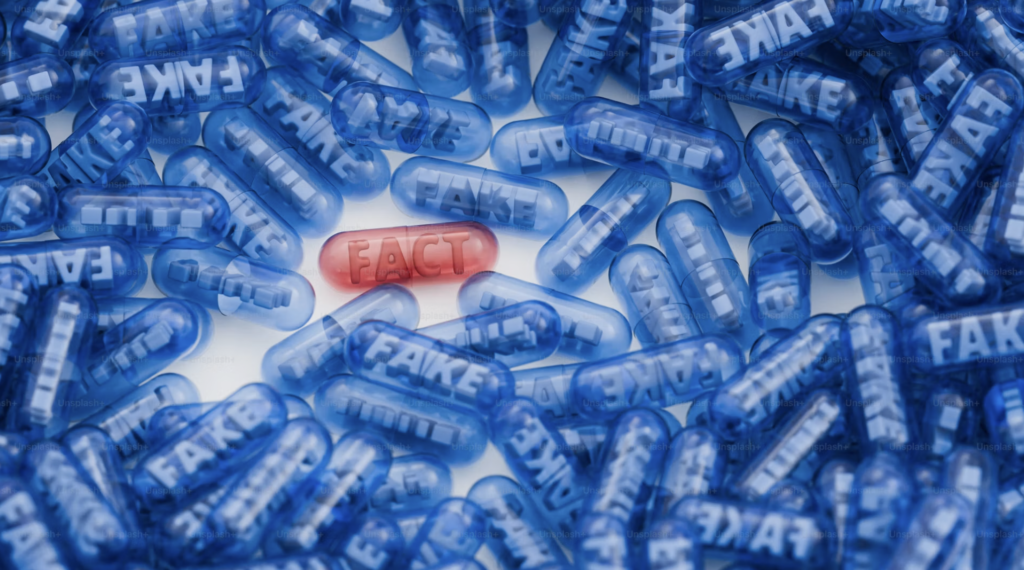
Kutsaiev, R. (2024). A red pill pill sitting on top of a pile of blue pills [3D render]. Unsplash.
One example of AI-amplified misinformation that has affected Canadians is the spread of AI-generated health information seen on social media. AI can be used to create realistic videos of fake doctors, or alter the voices and images of real medical professionals. This is concerning because people may trust the information as it seems like it is coming from a health professional. The Canadian Medical Association (2026) has warned about this misinformation, and found that Canadians that followed health advice from AI were 5x more likely to experience harm.
This type of misinformation has the potential to influence public opinion by making people believe false health claims, distrust medical professionals, or make decisions based on false information. The Harris Poll (2025) found that 56% of Canadians had encountered misinformation online. This also connects to the Media Literacy Week (MediaSmarts, 2025) resource because media literacy is about developing the critical thinking skills needed to evaluate information rather than automatically believing what we see online.
Proposed Media Literacy Curriculum Segment
“Real or AI? Navigating Social Media” would be a curriculum segment designed to teach learners about how to critically evaluate AI-generated social media content before believing it.
The segment would include examples of real and AI posts online, so learners can see how similar they might look. It would teach the benefits of being skeptical and questioning content. Learners would then be taught different ways to check information, such as through checking the source, looking for evidence, and searching for other reliable sources (MediaSmarts, 2021), and evaluate another set of posts. They would have to explain whether they would share the content and why, helping learners understand who created the information, why it was created, and how it could influence an audience.
This type of curriculum is justified by Canadian research showing how common online misinformation has become. The Canadian Medical Association (2026) reported that 69% of Canadians have become skeptical of health information they see online, even when it comes from sources they normally trust.
Overall, Canadian learners need media literacy skills that allow them to question, verify, and evaluate AI-generated information. Teaching these skills could help reduce the spread of misinformation and make people less likely to accept or share harmful content simply because it looks real.
References
Canadian Medical Association. (2026). Doctors warn: Canadians are turning to AI for health information and it is hurting them.https://www.cma.ca/about-us/what-we-do/press-room/doctors-warn-canadians-are-turning-ai-health-information-and-it-hurting-them
CBC News. (2026). Carney AI strategy. CBC. https://www.cbc.ca/news/politics/carney-ai-strategy-9.7223236
Gilmore, R. (2026). Carney has AI strategy for all, unless… Substack. https://rachelgilmore.substack.com/p/carney-has-ai-strategy-for-all-unless
Government of Canada. (2024). Learn about online disinformation. https://www.canada.ca/en/campaign/online-disinformation/learn-about-it.html
Innovation, Science and Economic Development Canada. (2026). Canada’s National Artificial Intelligence Strategy: AI for All. Government of Canada. https://ised-isde.canada.ca/site/ised/en/canadas-national-artificial-intelligence-strategy-ai-all
MediaSmarts (2021). What’s real online? | Media literacy lesson [Video]. YouTube. https://www.youtube.com/watch?v=JQZfNCd-iwI
MediaSmarts. (2025). “Wait… What?” Media Literacy Week highlights growing concern over AI-driven misinformation. https://mediasmarts.ca/about-us/press-centre/wait-what-media-literacy-week-highlights-growing-concern-over-ai-driven-misinformation
Prime Minister of Canada. (2026). Prime Minister Carney launches AI all, Canada’s new national artificial intelligence strategy. https://www.pm.gc.ca/en/news/news-releases/2026/06/04/prime-minister-carney-launches-ai-all-canadas-new-national-artificial
The Harris Poll. (2025). Misinformation and deepfakes: Young Canadians on alert. https://theharrispoll.com/articles/misinformation-and-clickbait-are-widespread-while-deepfakes-and-ai-manipulation-are-visible-and-rising-especially-among-young-canadians/
Hi Avery! Your example about AI-generated health misinformation was such a great choice, especially the point about people trusting fake doctor content simply because it looks like it’s coming from a real medical professional. That stat about Canadians being five times more likely to experience harm after following AI health advice really put the stakes into perspective. I also liked your “Real or AI?” curriculum idea, having students compare real and AI posts side by side seems like such a practical way to build that skepticism instead of just telling students to be careful. Awesome!
Hi Avery! I really enjoyed your blog post this week. I thought your example was super informative and mildly concerning. I echo Taryn’s statement that Canadians are five times more likely to experience harm after following AI health advice is really eye-opening. I also agree with your point that “media literacy is about developing the critical thinking skills needed to evaluate information rather than automatically believing what we see online.” Which, in my opinion, should be ingrained into the curriculum and be a basic skill to protect people from harm.
Hi Avery!
This was such an incredibly detailed blog post this week. I loved your inclusion of the Teacher Tips video for Media Literacy to extend learning. I also really appreciated the conversation around misinformation about health specific topics. Misinformation around health is extremely worrisome as it can lead to scary repercussions that affect everyone, such as outbreaks and even another pandemic. Thanks for sharing!
Hi Avery! I really liked your example about AI-generated health information because I feel like that’s one of those things people could easily believe if it looks like it’s coming from an actual doctor. It’s honestly a little scary how realistic AI content is getting and how hard it can be to tell what’s real anymore. I also really liked your “Real or AI?” activity because actually comparing posts seems way more helpful than just being told to fact-check everything. Great post!!
Hi Avery! I really liked this post as you mentioned the idea that people should be learning more and more about AI and how to incorporate it into their regular lives as it is something that is clearly here to stay so rather than avoiding it, we need to learn how to understand it, and use it for the right purposes. I liked your points on how you would teach AI to students as I think being able to tell a fake ai generated image from a real one is a very important skill, although it is becoming crazy hard lol. Thank you for sharing. I am also wondering if I can use this post for the final reflection?