Blog Post 6: Collaborative Reflection
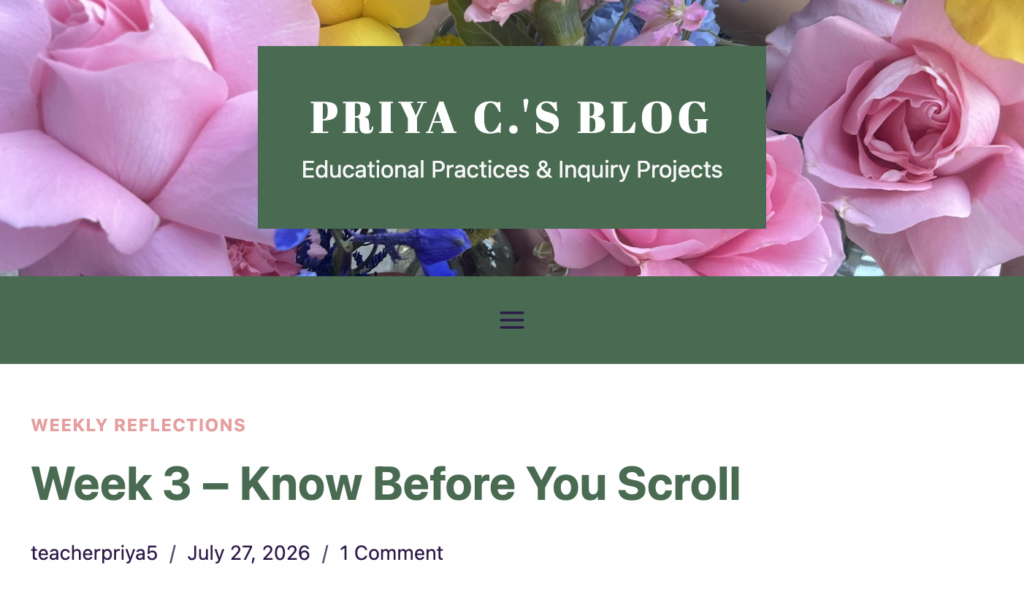
For this final blog post, I chose to look at Priya’s Week 3 blog post, as there were so many things that I enjoyed about it.
Priya did a great job connecting PLNs and social media to the future of education. Her information was accurate and supported well by different articles and examples. For example, her use of Dyer’s discussion of “the medium is the message” helped show how different platforms can shape communication and professional identity. I also really liked her statement that “social media is not a replacement for traditional learning but it can be used as a space where learning happens in a new way.” This helped show that she recognizes both the opportunities and limitations of using social media for education.
Gatewood, H. (2018). Watercolor wireframe sketches of website layouts [Photograph]. Unsplash.
Her post was also very clear and easy to follow. I liked the way she mixed in quotes, bullet points, as well as paragraphs. It made the post very visibly engaging. Her personal examples also made the post feel honest and relatable. They helped connect the concepts to real world experiences and ideas, like including one of her favourite educational Instagram pages.
Schoff, D. (2021). Person holding magnifying glass with black frame [Photograph]. Unsplash.
One area where she could strengthen her post is by providing a little more evidence for some of her claims. For example, when talking about how “social media communication is shaped by algorithms”, she could include a source explaining how algorithms influence what people see online. An example of this would be this article from Queens University of Charlotte: https://library.queens.edu/misinformation-on-social-media/algorithms
As well, the conclusion makes a strong point that “educators should approach social media with awareness of privacy, professionalism, and digital citizenship,” and adding a source or example here could make this argument even more convincing.
I also think her discussion of misinformation could be expanded. It would be interesting to explore what educators can actually do when they encounter unreliable educational content online. For example, you could discuss strategies for checking the credibility of a source or identifying potential bias. MediaSmarts’ Digital Media Literacy resources could provide useful research to support this section.
Overall, I thought this post provided a great perspective on the role of social media in education. I agree that educators will need to understand how to use these platforms responsibly rather than just avoiding them. This post does a great job showing that PLNs can create meaningful opportunities for educators while also requiring awareness of privacy and misinformation.
Message to Priya
It has been so great working with you in this class this summer! You have provided so many amazing perspectives and have taught me so much. I really enjoyed reading your blog posts, and you made working on the final assignment so stress-free. You were such a great teammate, and I really appreciated how easy and enjoyable you made the whole process. I hope we can keep in touch!
Thanks so much for the feedback Avery, I definitely agree with your points. It has been wonderful working with you this summer, I’ll be sure to keep in touch! 🙂