Blog Post #1: Personal Learning Networks and Digital Identity
Hume, C. (2018). Person sitting front of laptop [Photograph]. Unsplash. https://unsplash.com/photos/person-sitting-front-of-laptop-mfB1B1s4sMc
I have grown up having access to social media and other online platforms, and it has become the way that most of us communicate, build relationships, and find information. Prior to the readings and videos from this week, I have seen social media mainly as a place to connect with friends and family, share photos, and stay updated on current world events. I can see now that social media can be an important tool for learning and professional growth as well.
What is a Personal Learning Network?
BoliviaInteligente. (2023). A large group of colorful balls floating in the air [Photograph]. Unsplash. https://unsplash.com/photos/a-large-group-of-colorful-balls-floating-in-the-air-AXNZb4FEkh8
A Personal Learning Network (PLN) is a collection of people, communities, and online resources that support lifelong learning. PLNs allow people to continue to develop and gain new knowledge by connecting with others who share similar interests. The FutureLearn (n.d.) reading discusses lifelong learning, and explains that lifelong learning is even more important now as technology and society are constantly changing. People must develop their own digital competence to be able to adapt to these changes. As someone hoping to work in public health, I know that my learning will not end after university, and that I will need to continue to learn throughout my career to stay educated on new research, technologies and practices.
Digital Identity
Shatov, A. (2021). Blue red and green letters illustration [Illustration]. Unsplash. https://unsplash.com/photos/blue-red-and-green-letters-illustration-mr4JG4SYOF8
Digital identity, according to Stoller in What Is Digital Identity? (2016), is the information, interactions and content that represents us online. It is the information we create, as well as the information that others post about us. Digital professional identity, as discussed in Digital Professional Identity: Dear Internet! Who Am I? (Rajab et al., 2020), is our professional identity that develops through online interactions. As future employers, colleagues and clients may view my online presence, I want my digital identity to reflect professionalism, compassion, and respect, while still letting my personality and interests show.
Personal Learning Networks and digital identity are very closely related. The way we present ourselves online influences the opportunities we gain through our networks. Sharing volunteer experiences, research projects, and other community involvement can create many new opportunities, whereas inappropriate posts can negatively impact employment and relationships. We need to make sure we are sharing things online that align with our values!
Completing the digital identity exercise and reflecting on my own online presence was very interesting. I generally use social media responsibly, but I realize that sharing more about my volunteer work and academic experiences, as well as separating content intended for close friends from professional information, could be a worthwhile approach. Right now, I only have one personal account on social media sites such as Instagram and Facebook, but having separate accounts for my professional achievements is something I would like to have in the future.
We Love Networking!
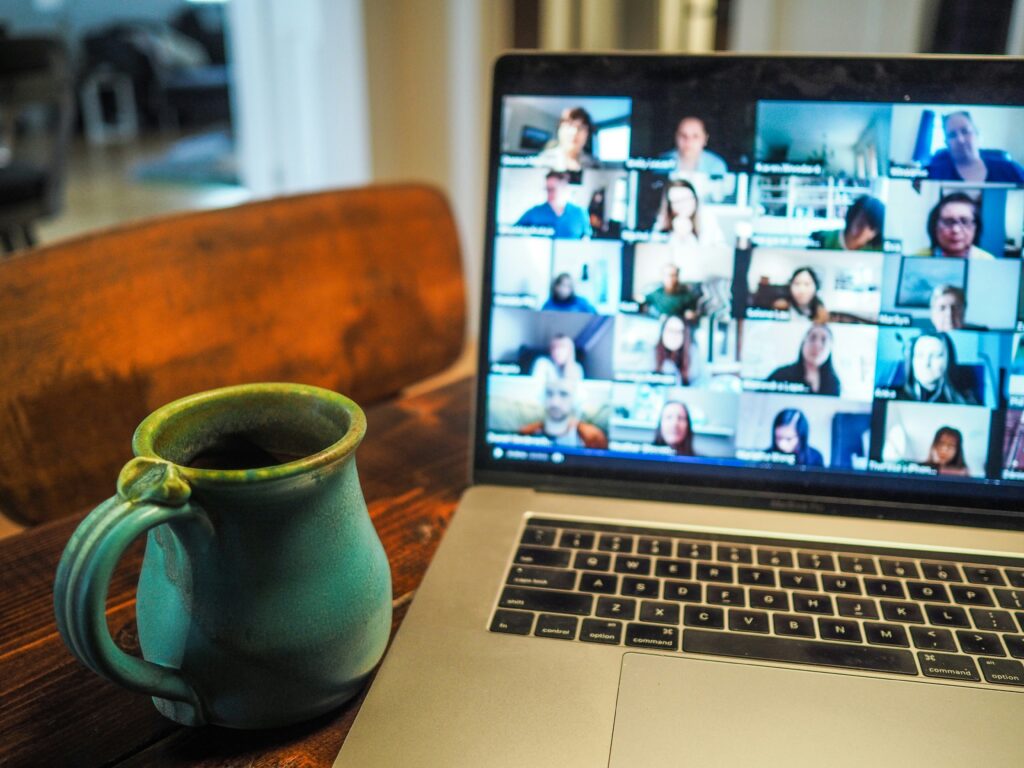
Montgomery, C. (2020). MacBook Pro displaying group of people [Photograph]. Unsplash. https://unsplash.com/photos/macbook-pro-displaying-group-of-people-smgTvepind4
Networking has been a key part of my life in university. It has given me many opportunities such as working for Pacific Coast Swimming, starting my volunteer role with the Victoria Brain Injury Society (VBIS), and eventually securing a summer student position with the organization. Through my work at VBIS, I have been able to connect through email and Zoom meetings with people from many other organizations. This has given me the opportunity to collaborate with other organizations professionally, as well as learn about different career paths. I have been able to ask professionals about how their organizations operate, what education and experiences led them to their role, and any advice they would have for students interested in their field of work. Connecting with professionals, researchers, and other students has exposed me to different perspectives and opportunities that I would not have found on my own.
Networking through social media, such as Instagram, Facebook and LinkedIn is not something I am as well-versed in. It involves more than just gaining followers. The reading on understanding personal learning networks (Rajagopal et al., 2012) explains that effective networking involves building and maintaining relationships with others who can contribute to our learning and professional development. This article talks about how strong connections often provide support and opportunities to work together, while weaker connections can introduce us to new opportunities. I found this very interesting, as I usually think of weaker connections as less worthwhile. I can understand now how this can instead be an opportunity for growth and a chance to learn.
Why are people online?
Karimov, Z. (2025). Instagram login screen with fields for username and password [Photograph]. Unsplash. https://unsplash.com/photos/instagram-login-screen-with-fields-for-username-and-password-pXmjGxwt33A
People are online for many reasons. In the past, I have seen social media as mainly a place for entertainment. Although, social media also allows people to connect with others, find new communities, learn from others, and be an advocate. Spracklen (2015) talks about how people can build their identity online and find communities of people they share interests with.
Social media has also been used for activism, fundraising, and raising awareness about important social issues. I have seen this firsthand, and have been involved in some of these fundraisers. I have participated in Facebook fundraising auctions in support of organizations such as Foundry East Kootenay, and more recently, have been fundraising for the Victoria Brain Injury Society. Social media has allowed me to share my fundraising campaign and reach people who may not have otherwise heard about the organization. These experiences, as well as these readings, have shown me that social media can be much more than a place for entertainment.
The Risks of Being Online
FlyD. (2021). Black and red laptop computer [Photograph]. Unsplash. https://unsplash.com/photos/black-and-red-laptop-computer-9PivUW7l1m4
Participating online also has risks, such as privacy concerns. Boyd (2014) explains that information online is easily searchable and replicated. Information can easily spread beyond our control. I found the discussion about algorithms interesting because it discussed how companies collect and analyze our information to create assumptions about who we are. Even when we carefully manage our privacy settings, our online activity continues to influence advertisements, recommendations, educational opportunities, and employment decisions. For example, in 2018, it was revealed that Cambridge Analytica had collected personal information from millions of Facebook users without their knowledge and used this data to create profiles that could be used for targeted political advertising. This shows how online information can be collected, analyzed, and used in ways that users may not be aware of (Cadwalladr & Graham-Harrison, 2018).
Spracklen (2015) also discusses how we surround ourselves with people who share similar interests and opinions, which can sometimes lead to misinformation and the “othering” of certain groups. For example, social media algorithms often show content similar to what the person has already engaged with. If someone frequently interacts with posts containing misinformation about vaccines or climate change, this will reinforce those beliefs and reduce the chance of the person being exposed to different perspectives.
Being Online Isn’t All Bad!
Despite these risks, there are also positive aspects to social media. It provides opportunities to collaborate with people around the world, build communities, and share knowledge quickly, which can be very helpful for students, professionals, and organizations. Stoller’s (2016) discussion of digital identity reinforced that our online presence is more than what we post, but also includes how we interact and help others. Our digital footprint becomes a part of our long-term identity, so it is important to make sure our online behaviour reflects our personal values and professional goals.
Final Thoughts
Overall, this week’s topic changed how I think about my online presence. Every post, comment, and interaction adds to my digital identity, so moving forward, I want to be more intentional about using social media, and continue learning and building new relationships.
Manas, R. (2023). A pile of colorful blocks with social icons on them [Photograph]. Unsplash. https://unsplash.com/photos/a-pile-of-colorful-blocks-with-social-icons-on-them-D5FEtPXHpPs
References
Boyd, D. (2012). Networked privacy. Surveillance & Society, 10(3-4), 348–350. https://doi.org/10.24908/ss.v10i3/4.4529
Cadwalladr, C., & Graham-Harrison, E. (2018). Revealed: 50 million Facebook profiles harvested for Cambridge Analytica in major data breach. The Guardian. https://www.theguardian.com/news/2018/mar/17/cambridge-analytica-facebook-influence-us-election
FutureLearn. (n.d.). What is a Personal Learning Network? FutureLearn. https://www.futurelearn.com/courses/learning-network
Rajab, M. H., Gazal, A. M., & Alkattan, K. (2020). Dear internet! Who am I? Digital professional identity and social media. Journal of Family Medicine and Primary Care, 9(1), 142–146. https://www.ovid.com/jnls/edhe/fulltext/10.4103/efh.efh_232_17~digital-professional-identity-dear-internet-who-am-i
Rajagopal, K., Joosten-ten Brinke, D., Van Bruggen, J., & Sloep, P. B. (2012). Understanding personal learning networks: Their structure, content and the networking skills needed to optimally use them. First Monday, 17(1). https://firstmonday.org/ojs/index.php/fm/article/view/3559/3131
Spracklen, K. (2015). Identity-Making and Social Media. Digital Leisure, the Internet and Popular Culture. Leisure Studies in a Global Era. Palgrave Macmillan. https://doi.org/10.1057/9781137405876_6
Stoller, E. (2016). What is digital identity? [Video]. https://www.youtube.com/watch?v=u0RryRbJza0
Wow, this is a well-referenced and visual post (an inspiration to me, which I hope to do more like this as well.) I also think that having separate accounts for Professional and Social audiences may allow me to be more targeted in what I post or share with whom. You made great connections to what you are doing through volunteering and collaboration with your future role. Thanks for sparking these ideas in me so that I can also do so when broadening my networks in education.