Blog Post #2: Personal Digital Identity vs Professional Digital Identity
Section 1: V and R Mapping
What is Visitor/Resident Mapping?
White and Le Cornu (2011) discuss two different ways people engage with the internet. A Visitor is a person that uses the internet for a specific purpose, such as searching for information, and then departing without leaving a lasting digital presence. A Resident is a person that uses the internet to create a lasting digital presence. They interact, post content, and develop relationships with others. Visitors and Residents are not fixed categories, as people may be a Visitor on one platform and a Resident on another.
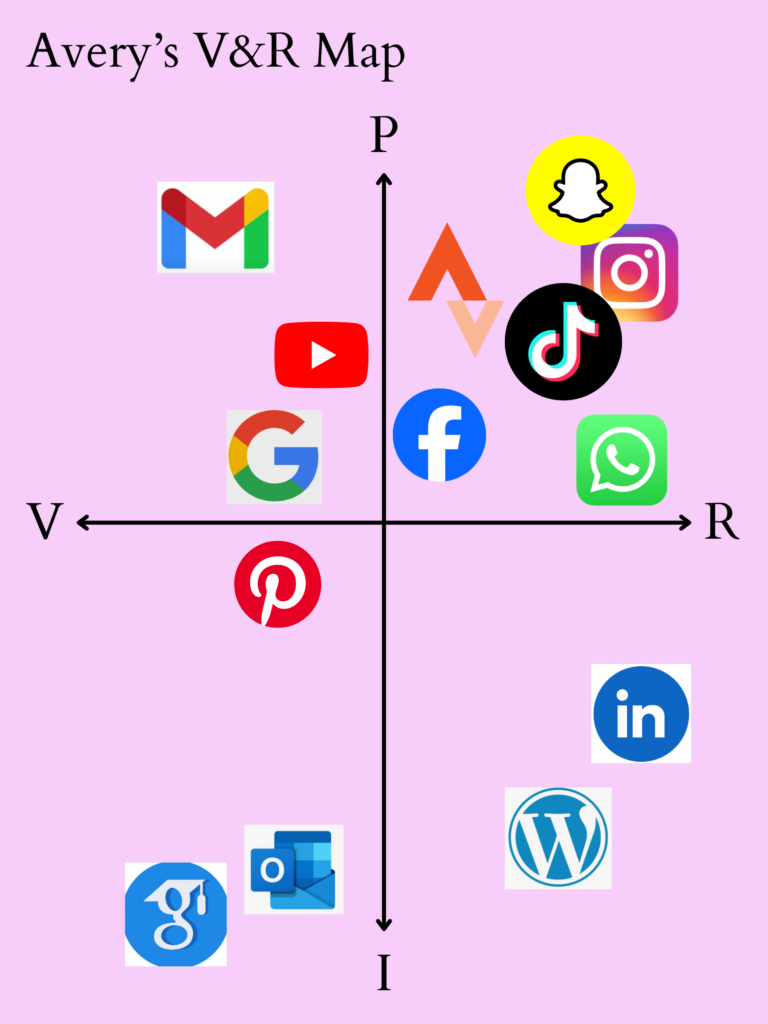
Sikkes, A. (2026). Avery’s V&R Map. [Canva design]. Canva.
Creating my Visitor and Resident map showed me how easily my online identity can change based on my engagement. My identity depends not only on the platform, but also the way I use it. For example, I use Pinterest both for professional and institutional reasons. The Visitor and Resident model also helped me understand that a digital identity is not only created through what I intentionally put online, but also how I communicate with others and participate in communities. As I become more involved in professional spaces, I need to be careful about what information I share and how my online activities may influence my digital reputation. My map demonstrates that I move between Visitor and Resident depending on my goals. I am a Visitor when I use the internet primarily as a tool, but I become a Resident when digital spaces are places where I communicate, learn, build relationships, and develop my professional identity.
Section 2: PLN & Digital Identity
What digital platforms are students currently using to develop their professional network?
dlxmedia.hu. (2022, June 25). Icon [Photograph]. Unsplash.
Students today use many different digital platforms. I find that LinkedIn is one of the most widely used platforms, as students can not only display their experiences and achievements, but also connect with others and explore career opportunities. Students may also use media such as Instagram and YouTube to learn from experts and connect professionally with others. I have personally found LinkedIn the most valuable for connecting with others. Through LinkedIn, I have been able to network and share knowledge with other organizations and professionals, as well as learn about new research and community work. I hope to keep developing my professional network through LinkedIn, but also expand and start using different platforms for learning, growing and forming new relationships.
What could the student consider in expanding their professional learning network?
Schwarz, C. (2021, June 11). Graffiti on a wall that says, only in diversity [Photograph]. Unsplash.
Throughout developing my professional learning network, I have seen how important it is to connect with others with diverse perspectives, rather than only working with people who think similar to me. Engaging with many different individuals, such as researchers, organizations, and individuals with lived experience has introduced me to many new ideas and approaches. For example, working at VBIS has shown me the importance of learning directly from people with lived experience rather than relying on textbooks, Google searches, or slideshows. Through conversations with clients, caregivers, and other professionals in the field, I have been exposed to new perspectives that have strengthened my understanding of brain injury, inclusion, and community. Therefore, having a diverse group of perspectives to help you learn is something I think the student could benefit from when expanding their professional learning network.
Consider in your blog submission how an employer would respond if you applied for a job with them, and they assessed your social media presence via your digital identity.
Shalabaieva, M. (2023, May 10). A group of different social media logos [Digital image]. Unsplash.
The way a future employer would view me would depend on the social media platform they are looking at. I rarely post on Facebook, and I primarily use Instagram to share my personal photos. In contrast, I use LinkedIn for professional networking, and highlighting my education, work and volunteer experiences.
If a future employer reviewed my social media presence, I would want them to see someone who communicates respectfully and values inclusion. As someone who represents different organizations, through delivering presentations and participating in community outreach events, I recognize that my online presence can reflect not only myself but also the organizations and communities I am connected to. This has encouraged me to be thoughtful about what I post online, and only share things that align with my personal values.
Overall, I believe that my digital identity is still growing and has lots of room for improvement. While I am considerate about what I post online, I do not share enough about my achievements, my interest in psychology, and my passion for disability advocacy, community engagement, and education.
How do data privacy and security limit and/or promote a PLN? In your network, how can you create a digital identity reputation?

FlyD. (2021, February 23). Red padlock on black computer keyboard [Photograph]. Unsplash.
Social media makes it easier to build relationships and access educational resources, but it also raises concerns about privacy, surveillance, and ownership of personal data. Regan and Jesse (2019) argue that individuals should understand how their information is collected, stored, and used while maintaining autonomy over their personal data. These concerns remind users, like myself, to think carefully about what they choose to share online. As I continue building my professional identity, I try to regularly review privacy settings and think carefully before posting content publicly. I want my digital identity to show that I value communication, respect confidentiality, and add positively to professional discussions.
Section 3: My PLN – Inclusion & Community Engagement
How diverse is your PLN?
My PLN is diverse, but still has lots of room to grow. Currently, my PLN includes classmates, professors, researchers, advocates, and community organizations. Many of these relationships have been formed through the university and my courses, my research assistant position, and my employment in various workplaces. I would like to further diversify my PLN by gaining perspectives from different cultures, identities and professions throughout my future education and employment.
Are you learning from a variety of diverse voices and are you expanding your understanding of the views of others?
I have learned that one of the most valuable aspects of my PLN is learning from people whose experiences are different from my own. For example, working with individuals living with brain injuries and my research on caregivers has further proved to me that every person’s experience is unique. These experiences have broadened my understanding of accessibility and inclusion far beyond what I have learned in the classroom. Moore and Schnellert (2016) argue that inclusion begins by recognizing and valuing each person’s unique strengths rather than trying to make everyone the same. This idea has influenced both my education and my interactions within my professional network. In the future, I would like to keep growing my inclusive perspective of others, and continue listening to a variety of diverse voices.
What is a learning outcome of your PLN, and how are you ensuring your exposure to diversity and inclusion?
One important learning outcome has been developing a deeper understanding of inclusion and disability advocacy. Before volunteering at VBIS, much of my understanding of brain injury came from textbooks. Through working with clients, families, and professionals, I have learned how valuable lived experience is in shaping meaningful support. This experience has reinforced the importance of building a PLN that includes researchers, healthcare providers, community organizations, and individuals with lived experience. Learning from all of these perspectives helps me become more empathetic and informed. This also relates to the video by Five Moore Minutes (2026), which discusses how inclusion continues to evolve, and requires us to acknowledge and value the identities and experiences of others. Rather than trying to change or speak for the individuals that I work with, meaningful inclusion involves listening, learning from their experiences, and ensuring that their voices are valued and heard. As the video emphasizes, we should reach out, learn about, and learn from one another rather than suppressing or trying to change each other’s identities.
Section 4: How has my thinking about inclusion and PLN evolved?
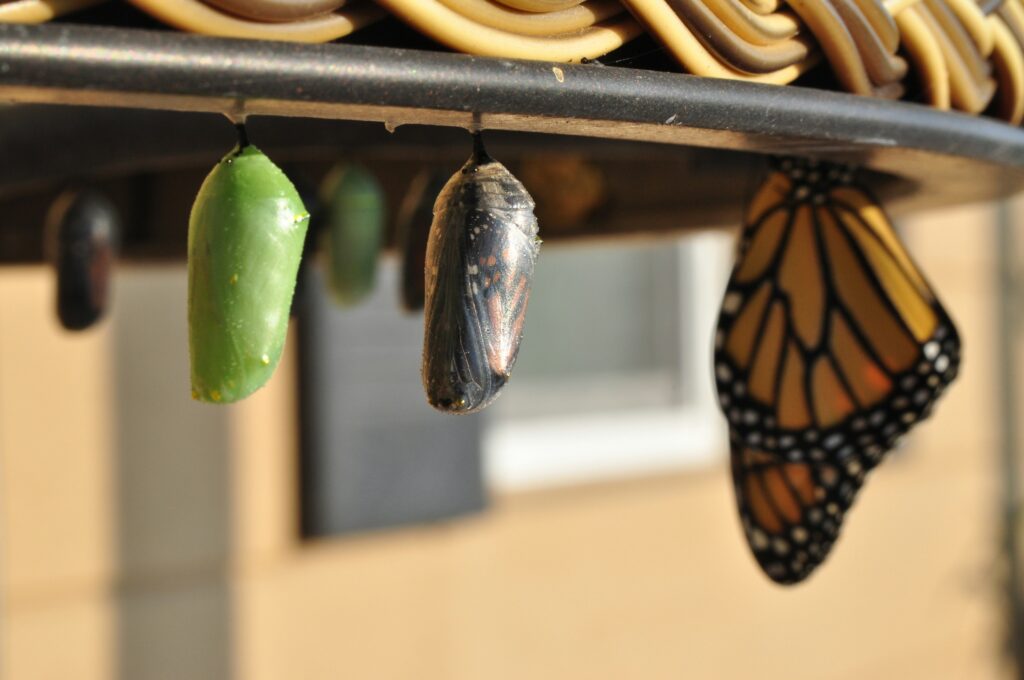
Williams, S. D. (2018, August 25). Three pupas [Photograph]. Unsplash.
Throughout this course, I have realized that inclusion is much more than simply acknowledging diversity. True inclusion means creating environments where every individual feels valued and has opportunities to contribute. Moore and Schnellert (2016) explain that education should focus on recognizing what each person brings rather than trying to make everyone fit the same standard. This idea strongly connects with my experiences at VBIS. Every client has different strengths, challenges, and goals, and no two recovery journeys are the same. Working in this environment has reinforced that inclusion means adapting supports to meet individual needs rather than expecting everyone to follow one path. My PLN reflects this understanding because I actively seek voices from people with different experiences and backgrounds.
Social media can play an important role in creating more inclusive professional communication. It allows organizations and individuals to share information, connect with communities, and educate others. Clark and Aufderheide (2011) explain that digital public media can create opportunities for people to participate, exchange information, and communicate across social and cultural differences. For myself, social media, such as the VBIS Instagram account, can be used to share information about brain injury, mental health, accessibility, and community resources while also highlighting the voices of individuals with lived experience. My PLN can also amplify the views of others. Rather than using social media only to share my own ideas and experiences, I can share ideas and resources created by others.
At the same time, social media can create challenges for communication. Information can be misunderstood, taken out of context, or shared without considering how it may affect different people. Content can influence how others look at an individual or organization, meaning we have to be very considerate of how we portray ourselves online.
A diverse and inclusive PLN benefits both my own learning and the communities I hope to work with in the future. Exposure to different perspectives can challenge assumptions and strengthen my knowledge. It can also improve the way I share information, as I will be more considerate of how a message may be interpreted by others.
Overall, building an inclusive PLN means intentionally seeking out diverse voices, recognizing others strengths, and considering how my own voice can impact others. As I continue to develop my professional digital identity, I hope to use social media in a way that promotes respectful communication, amplifies the voices of others, makes others feel heard and respected, and contributes positively to the community.
References:
Clark, J., & Aufderheide, P. (2011). A new vision for public media: Open, dynamic, and participatory. In V. Pickard & D. McChesney (Eds.), Will the last reporter please turn out the lights? Palgrave Macmillan. https://link.springer.com/book/10.1057/9780230119796?v3=true
Five Moore Minutes. (2025). Inclusion is not assimilation: Understanding communities of identity and diversity. [Video]. YouTube. https://www.youtube.com/watch?v=5IOGOE_qQfM
Moore, S., & Schnellert, L. (2016). One without the other: Stories of unity through diversity and inclusion. Portage & Main Press. https://ebookcentral.proquest.com/lib/uvic/reader.action?docID=4832579&p++pg=11&c=RVBVQg&ppg=1
Regan, P. M., & Jesse, J. (2019). Ethical challenges of edtech, big data and personalized learning: Twenty-first century student sorting and tracking. Ethics and Information Technology, 21(3), 167–179. https://link-springer-com.ezproxy.library.uvic.ca/content/pdf/10.1007/s10676-018-9492-2.pdf
White, D. S., & Le Cornu, A. (2011). Visitors and residents: A new typology for online engagement. First Monday, 16(9). https://firstmonday.org/ojs/index.php/fm/article/view/7802/6515