Public PLN – Balancing PLN, Media Literacy, & Public Discourse
Social Media and a Critical Public Audience
Notable People and Social Media
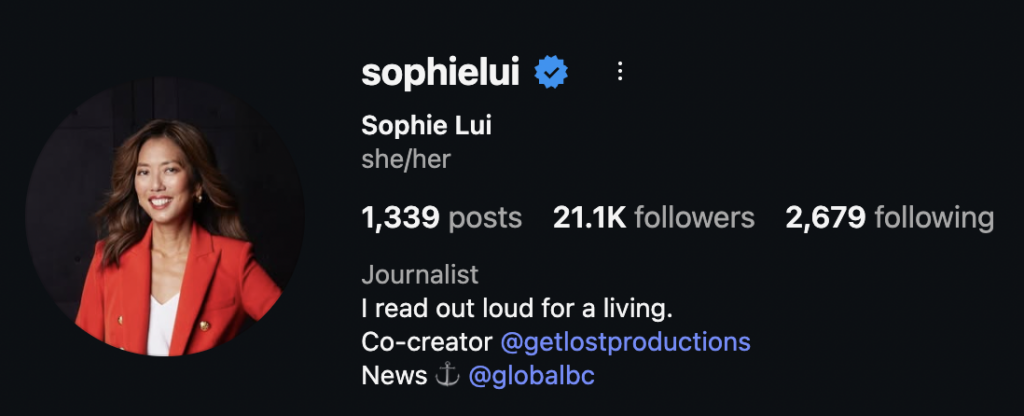
Screenshot taken from Instagram profile of Sophie Lui (2026).
The video with Sophie Lui (Miller, 2026) made me think about how notable individuals use different social media platforms for different reasons. She talks about how she may share more personal parts of her life on Instagram, while using Twitter in a more professional way. I think this is something we see often, even when people are not famous. For example, I use Instagram more personally, while LinkedIn is more professional. Although we all have to be conscious of what we put online, I think that notable individuals have to be especially careful. They are reaching a much larger audience, and things can be easily taken out of context or publicly criticized.
In the Public Eye
Being in the public eye can make building connections, sharing information, and creating communities much easier. A PLN can help someone learn from others, find new opportunities, and connect with people who have similar interests. Being a more ‘notable’ person and having a PLN allows people to show more personality and connect with people deeper than they may have been able to without social media.
Although, as Sophie Lui discussed, people can be negative and unkind online. Being in the public eye also means exposing yourself to potentially being misunderstood, shared without context, or criticized. Even if something you put online is not necessarily ‘bad’, it can still be connected back to the people or organization you represent, which could potentially be harmful.
Building Community with an Employers Tools
Hardie, E. (2022). A close up of a computer screen with some stickers on it [Photograph]. Unsplash. https://unsplash.com/photos/a-close-up-of-a-computer-screen-with-some-stickers-on-it-ZtXmxLV11qk
Online tools provided by an employer can be helpful as they provide a more professional space to communicate, connect, and share information with other employees. I have experienced this through using Microsoft Teams regularly at the Victoria Brain Injury Society and in my research lab. MS Teams makes it easier to communicate with coworkers and lab members, share information, and stay connected, even when everyone is not in the same place. At the same time, using a platform like this creates professional boundaries and guidelines around how people should communicate and what information should or should not be shared. This helps protect the employees, as well as the organization overall.
Although, these tools can potentially feel limiting. People may feel like they cannot express their opinions freely, and have to be very careful to not share inaccurate or inappropriate information, as it could negatively impact the organization they work for.
A Reliable PLN
I think building a reliable PLN means being intentional about who I follow and what information I trust. Only following people who have the same beliefs and opinions as I do can create conformity and an echo chamber. However, I want to make sure I am not expanding the information I trust to include unreliable sources.
The MediaSmarts (2021) video gave some useful ways to check information, such as:
- Looking for the original source.
- Searching for other reliable sources.
- Using a reverse image search.
- Checking to see if the information has already been identified as a hoax.
For topics related to my education and future career, I would want to follow reliable organizations, researchers, and professionals. Using sites such as the UVic library to search for reliable articles is one that I use often.
I find that there is often a lot of misinformation spread on social media sites such as TikTok. People see fake news, and immediately assume that it is real because it is popular online. We need to make sure, mostly when considering a reliable PLN, that we are only believing trustworthy people and websites, and fact-checking if we need to. This discussion reminded me of a clip of Keke Palmer in an interview with WIRED talking about how she remembers the first time she was ‘killed on Twitter’. This example can show how people can believe and share information simply because it is trending.
Veteran Storytellers – How Do They Minimize Risk in Sharing Misinformation?
Winkler, M. (2020). A close up of an old fashioned typewriter [Photograph]. Unsplash. https://unsplash.com/photos/a-close-up-of-an-old-fashioned-typewriter-aId-xYRTlEc
I think experienced storytellers and journalists minimize the risk of sharing misinformation by checking their sources, looking for the original information, and considering whether something is actually reliable before sharing it. However, even experienced people can make mistakes. Sophie Lui (Miller, 2026) talked about how she sometimes starts to respond to something online but then stops herself before sending it. Social media moves very quickly, and people can feel pressure to be the first person to share information or reply to a comment. But, being first is not always more important than being accurate. Taking time to check information before sharing it can help reduce the spread of misinformation.
Media Literacy
To me, media literacy is the ability to understand, evaluate and create media. Trilling and Fadel (2009) explain that media literacy includes understanding different forms of media, such as print, graphics, animation, audio, video, and websites.The House Hippo example from the MediaSmarts video (2021) showed how easily we can be influenced by what we are shown. If we only see part of a situation, such as through short videos, edited images, and headlines, it can seem completely different from the full reality.
Media literacy is important because we are constantly surrounded by media and information online. As the MediaSmarts video demonstrated, it is becoming more and more difficult to tell what is real online. Another example that I can think of is misinformation being spread through the COVID-19 pandemic, where some information surrounding COVID being spread was inaccurate and taken out of context. Misinformation can negatively affect many people, which is why it is so important to be responsible and check your sources. The reading about fake news (Hirst, 2018) explained that misinformation can take many different forms. It can be completely fabricated, but it can also be things that people misunderstand, advertising that looks like news, clickbait, propaganda, or information that contains some truth, but is misleading. I think media literacy can be dismissed because people can assume they are better at judging information than they are. But, misinformation is not always obvious. Media literacy can also be time consuming, and sometimes people may just accept something rather than spending time to check sources.
Information literacy is also an important part of media literacy. Trilling and Fadel (2009) explain that students should be able to access information efficiently, evaluate it critically, and use information accurately. We need to consider whether the information is credible, accurate, reliable, and relevant.
Varied Views, Factual Consensus
I think it is important to have varied views in my PLN because I do not want to only surround myself with people who have the exact same opinions that I do. As discussed in the previous blog post, being exposed to diverse perspectives can help me learn and challenge my initial assumptions. As well, people can have different opinions, but come to the same conclusion. For example, people may have different opinions and ideas about how brain injury awareness should be promoted, but can still come to the same conclusion about the prejudice and stereotypes we see regarding people with brain injuries.
A Critical Public Audience
Curating my social media with a critical public audience means being intentional about what I post and share, and really thinking about how something could be interpreted by someone who does not know me. As well, I would still want my social media to reflect my personality and values, as I do not think that having a professional critical identity means hiding my personality completely.
The Risks and Benefits of a Public Audience
The biggest benefit of engaging with a public audience in a media space would be being able to connect with more people. I would be able to share information easier, build new relationships, and learn from others. The risks include things like privacy concerns, harassment, and misinformation. It is also easier for people to say harmful things online, as they do not have to be face-to-face with the person they are critiquing.
The Risks for a Public Figure
I think that people in positions of trust have a greater responsibility to be meaningful about what they put online, as people are more likely to believe what they say. People in these positions are assumed to be knowledgable an reliable. As well, these people commonly represent organizations or professions, and their social media activity could affect how people view their work.
How to Address Negative Critiques
Negative critiques should be handled with patience and understanding, even if we don’t want to. I think it is important to listen to someone’s critique, and see if I can learn from it. People may also just want to start an argument or be hurtful, and in those cases, I try not to engage. I have had to learn how to do this, as it is easy for me to react emotionally when criticized. Instead, I have found it much more productive to use it as a learning experience.
Open Dialogue and Creating Conflict
I think that open dialogue can often create conflict as people can be personally connected and attached to what they believe. They may feel like they are being attacked or criticized when someone questions something they are passionate about. The reading about fake news (Hirst, 2018) also showed that people may be exposed to information that confirms what they already believe. When someone challenges that information, it can feel threatening. Social media can also worsen this, as people can respond to others quickly without thinking. Even Sophie Lui (Miller, 2026), discusses how she has started to respond to a comment on Twitter multiple times, and has had to stop herself. It is easy to want to immediately defend yourself, mostly when it is as simple as posting a comment online.
The Benefit of Having a PLN That Values Media Literacy
For me, the biggest benefit would be that my PLN would help me become a more educated person. I can make sure that all the information I consume is reliable, and that I am only sharing trustworthy information that aligns with my values. I can also be open to diverse opinions, and admit when I am not sure about something. I think that all of us should be skeptics, and be open to fact-checking and learning new things.
Personal Learning Networks and Education
Ahmad, S. (2026). People on a video conference call [Illustration]. Unsplash. https://unsplash.com/illustrations/people-on-a-video-conference-call–w9t1hDo9u8
As we have seen, PLNs can help people connect with others and share information. This can play an important role in education. Communication is no longer limited to face-to-face conversations, but is now extended to social media, blogs, and other online tools. Now, people can share information and create relationships with others throughout the world.
The video Education in a Connected Culture (Dyer, 2016) talks about how communication has changed over time. New technologies and media have created new ways for people to connect and share. This can have both negative and positive impacts on communication. For example, some things like body language are better communicated in person. However, online communication allows people to connect with people who they may not have had the opportunity to connect in-person with otherwise. The video also discussed how online and offline spaces are not completely separate. People often talk about things they saw online in person, and real-world events are discussed online. This means that the boundary between online and offline communication continues to become less distinct. This relates to PLNs because learning and professional growth can happen through both online and offline connections.
The reading by Couros (2010) also discussed the importance of openness, collaboration, and sharing in education. Social media and other online tools have made it easier for people to create, publish, and share content. This can support education because learners are less limited to information provided by a teacher or textbook. Social media can also provide opportunities for people to discuss issues that may be difficult to talk about in classroom settings. For example, someone may feel more comfortable sharing their experience or perspective online than speaking about it face-to-face with peers.
However, there are also problems with using social media in educational settings. Information can spread quickly, even when it is inaccurate. Social media can also make it difficult to separate personal opinions from professional information. There can also be concerns related to privacy, boundaries, and professionalism. These concerns are crucial when working with vulnerable populations, where privacy is especially important. Through my work with VBIS, I interact with people who may be living with brain injuries and their families. This means that I need to be thoughtful about what information I share online, such as being sure to not share personal or identifying information about clients on social media.
I think social media can be useful in education and professional settings, but it needs to be used carefully. Platforms such as LinkedIn can help people build professional networks, while platforms such as YouTube can provide educational information. As Dyer (2016) discussed, people communicate differently depending on the platform and the audience they are communicating with.
Overall, there are many positives and negatives to using digital media when developing a PLN. If used thoughtfully and carefully, digital media can be an excellent tool for building connections, sharing information, and developing a professional learning network.
References
Couros, A. (2010). Developing personal learning networks for open and social learning. Emerging technologies in distance education. (pp. 109–128). AU Press. https://www.aupress.ca/app/uploads/120177_99Z_Veletsianos_2010-Emerging_Technologies_in_Distance_Education.pdf
Dyer, H. (2016). Incorporating & accounting for social media in education. TEDx Talks. YouTube. https://www.youtube.com/watch?v=ZteEZbAtsNI
Hirst, M. (2018). Navigating Social Journalism: A Handbook for Media Literacy and Citizen Journalism (1st ed.). Routledge. https://doi-org.ezproxy.library.uvic.ca/10.4324/9781315401263
MediaSmarts (2021). What’s real online? | Media literacy lesson [Video]. YouTube. https://www.youtube.com/watch?v=JQZfNCd-iwI
Miller, J. (2026). EDCI 338 A02 – Media literacy LUI [Video]. YouTube. https://www.youtube.com/watch?v=f4fp-71OkO8
Trilling, B., & Fadel, C. (2009). 21st century skills: Learning for life in our times. Jossey-Bass. https://tinyurl.com/4n2cn89n
You have made great connections to each reference to your own context in meaningful ways. I like how you aproached how to deal with negativity and criticism by using patience and understanding. You clearly stated how to avoid misinformation by taking time to check the information we publish before it becomes a bigger problem.
Thanks Joshua! Patience and understanding is definitely not always easy, but can be a good solution to negativity when done right.
Hi I love your blog set up! I can tell you have put lots and time and effort into it, as well as the content in your blog! It’s so cool how you are utilizing Teams are your Research Job and being able to relate your online skills to this course! I also liked what you said about learners no longer being limited to information strictly from textbooks and teachers, thanks for your insight!